This note is focused on the area of vector field and tensor analysis. There are many coordinates in Physics, they are arranged in the many systems. The above ones we are going to talk are all limited to the three dimensional Euclidean condition(space dimension, time is not considered).

Derivatives in different coordinates

Polar coordinates

For the vector field in polar coordinate, such as the case of the equation of an elliptic ρ=ρ(θ)\rho = \rho(\theta). At the same time r,θr, \theta are also functions of time as r=r(t),θ=θ(t)r=r(t), \theta =\theta(t) .The directional vectors in radial and polar direction are changing with time.

Derivative of radia directional vector

der⃗dt=dθdteθ⃗=ωeθ⃗\frac{d\vec{e_r}}{dt}=\frac{d\theta}{dt}\vec{e_\theta}=\omega\vec{e_\theta}
Full proof of this derivation reuquire analysis of micro geometry structure and detailed definition of the limitation.
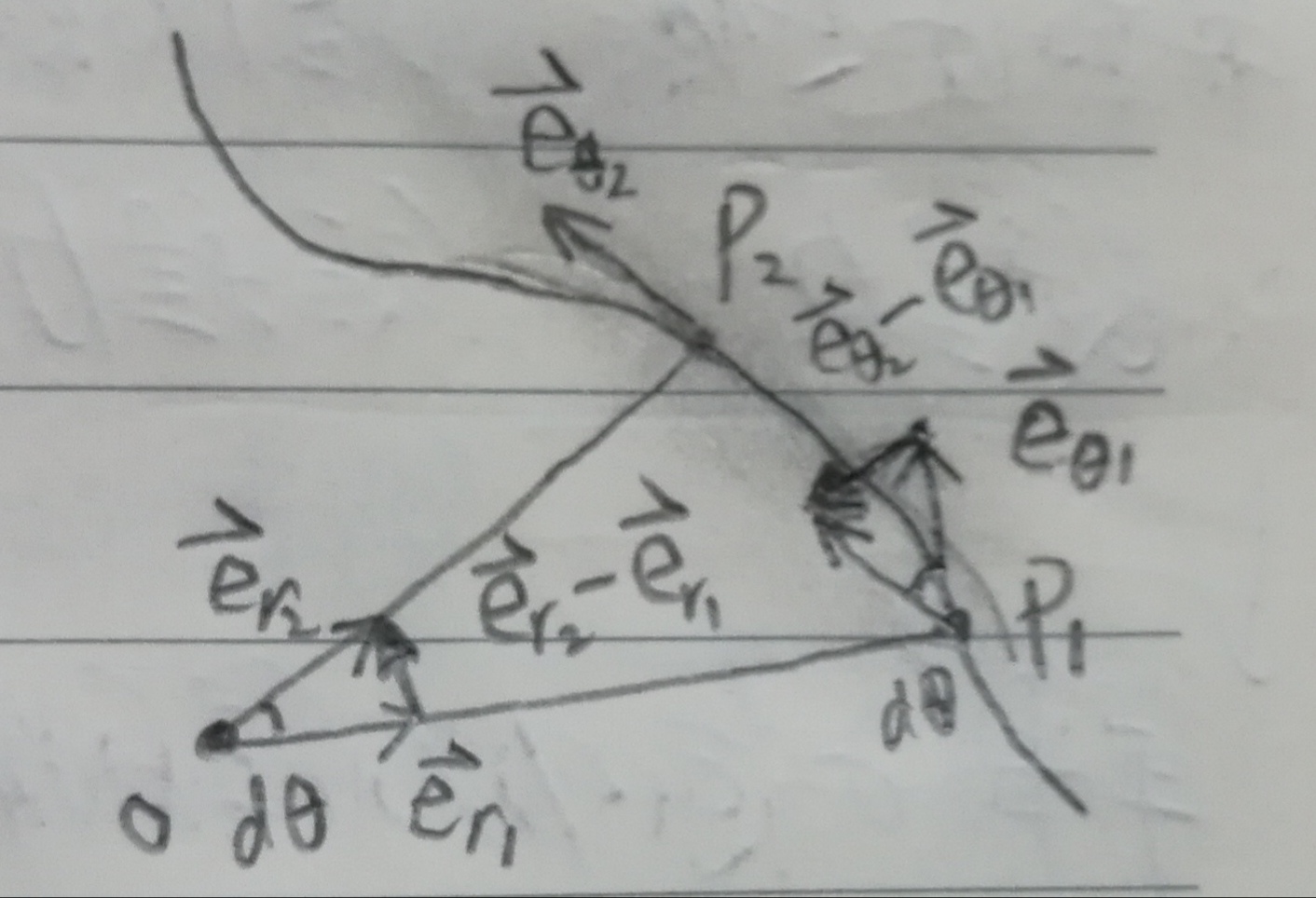
der⃗dt=lim⁡Δt→0er2⃗−er1⃗Δt=lim⁡Δt→0Δl⃗Δt=lim⁡Δt→0∣er⃗∣Δθeθ⃗Δt=dθdteθ⃗=ωeθ⃗\frac{d\vec{e_r}}{dt} = \lim_{\Delta t \to 0}\frac{\vec{e_{r2}}-\vec{e_{r1}}}{\Delta t} = \lim_{\Delta t\to 0}\frac{\Delta\vec{l}}{\Delta t} = \lim_{\Delta t \to 0}\frac{|\vec{e_r}|\Delta\theta \vec{e_\theta}}{\Delta t} = \frac{d \theta}{d t}\vec{e_\theta} = \omega\vec{e_\theta}

Derivative of poloidal directional vector

deθ⃗dt=−dθdter⃗=−ωer⃗\frac{d\vec{e_\theta}}{dt}=-\frac{d\theta}{dt}\vec{e_r}=-\omega\vec{e_r}
The derivation process is very similar to the case above.

deθ⃗dt=lim⁡Δt→0eθ2⃗−eθ1⃗Δt=lim⁡Δt→0Δs⃗Δt=lim⁡Δt→0∣eθ⃗∣Δθ(−er⃗)Δt=−dθdter⃗=−ωer⃗\frac{d\vec{e_\theta}}{dt} = \lim_{\Delta t \to 0}\frac{\vec{e_{\theta 2}} - \vec{e_{\theta 1}}}{\Delta t} = \lim_{\Delta t \to 0}\frac{\Delta \vec{s}}{\Delta t} = \lim_{\Delta t \to 0}\frac{|\vec{e_\theta}|\Delta\theta(-\vec{e_r})}{\Delta t} = -\frac{d\theta}{dt}\vec{e_r} = -\omega\vec{e_r}

Derivatives in polar coordinates{width=200px}